Michael Walther
Atlantic Crossing with Obstacles
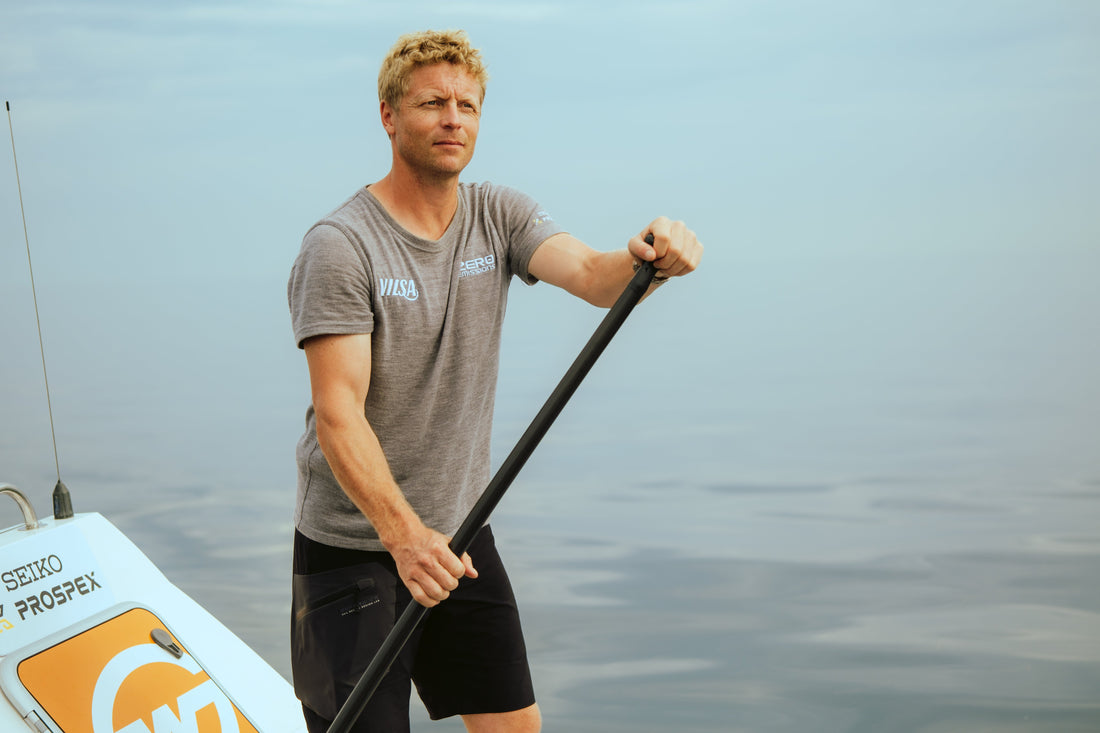
His extraordinary ZEROEMISSION project has come to an unexpected end: After about 1,000 kilometers, Michael Walther had to abort his Atlantic crossing by stand-up paddleboard (SUP). His board collided with an unknown object in the open Atlantic on Wednesday night. The structural damage made it impossible to continue, and Michael had to paddle to the port of Puerto del Rosario on Fuerteventura.
Despite the abrupt end, his message remains clear: step by step, paddle stroke by paddle stroke – big changes require courage, endurance, and conviction.
When Michael stepped onto his stand-up paddleboard a few days ago, nothing less than the Atlantic lay before him. 6,000 kilometers of water, wind, and waves separated him from French Guiana – the destination of his next big mission. For many, this sounds like madness. For Michael, it's a mix of adventurous spirit, conviction, and responsibility.
Born in Norderney, he is an extreme athlete, lawyer, and environmental activist. He became known for his spectacular ocean tours – and for his clear words on climate change. In conversation with us, he provides insights into his preparation, his motivation, and why there is no "neutral" for him when it comes to the future of our planet.

Training between Technique and Limits
Before Michael headed out to the open sea, he had intensively tested his equipment. "As a training tour, I actually did a 50-60 kilometer tour just to get a feel for it," he says. The focus was less on endurance and more on technical aspects.
His board is significantly larger and heavier than a normal SUP.
"If I pull through fully, it's very hard on the joints and tendons because the board doesn't give," he explains. "With a normal SUP, the board accelerates immediately. Here, I could theoretically break a paddle if I pull too hard."
His sleep rhythm also needs to be trained. During the day, he plans to sleep in stages to escape UV radiation – two hours of sleep, three hours of paddling, then rest again. The first few days, off the busy Portuguese coast, will be particularly strenuous.
Adventurous Spirit and Responsibility
Why would one voluntarily embark on months of solitude on the ocean? Michael has a clear answer:
"I simply enjoy experiencing such things. It's exciting to get to know myself in such exceptional situations – that feeling when I paddle off from Portugal and the coast disappears behind me." But there's more to the adventure. Michael also sees his journey as a statement. "We have to change something. We have to get out of our comfort zone. If I stay on the shore, I'll never arrive. But if I make the first paddle stroke, I have a chance."
He speaks openly about his motivation to do his part – not out of duty, but from an inner drive. "I don't want to stand before the next generation later and say: I knew it, but I did nothing. There's hardly any neutrality on this issue."
 From Law School to Climate Conviction
Michael studied law – and that's no coincidence. "Many wonder why I didn't become a marine biologist. But law fits perfectly: It's about justice. For future generations, for people in other regions, for fairness."
His commitment goes far beyond sports. He is committed to taking responsibility and making a social impact. "For me, it's not about labels, but about impact. Everyone can contribute in their own way – that's what drives me."
Between Fears, Experience, and Trust
Michael is not a daredevil, but an experienced sailor. As early as 2005, he sailed a long-distance regatta between Stockholm and Finland – five days non-stop on a catamaran at the Archipelago Raid. "Such experiences help me tremendously today," he says.
Panic attacks at sea? Possible, but unlikely. "I feel at home on the water. I know that 60% of the time will be strenuous, but I look forward to the beautiful moments."
An example of this: "Many ask how I can get into the water at 5,000 meters deep to clean the boat. But whether it's 5 or 5,000 meters – that's purely mental. Humans swim on the surface."

Boris Herrmann, Tech Talk & a Strong Network
Anyone who knows Michael knows: He's not alone. An important companion in the preparation is none other than Boris Herrmann, Germany's most famous offshore sailor.
"We've been in a lot of contact recently," Michael says. "We talked about his stove – he'd attached a tap to it after burning himself once. I immediately replicated it. I wrote to him on WhatsApp, and 30 seconds later a photo arrived. He was probably on board, tinkering and sailing."
In addition to Boris, meteorologist Sebastian Wache is also part of his team, as is his brother, an offshore expert at Siemens Gamesa. "He knows me very well and remains calm when something happens – that's exactly what I need."
Adventurous Spirit & Sustainability – a Common Language
Michael starts his Atlantic journey in Portugal – exactly where our 8beaufort.Hamburg sneakers are also made. In traditional family businesses, recycled sailcloth is combined with merino wool and other materials to create durable, fair shoes.
Thus, Michael's journey across the ocean symbolically connects what also drives our brand: adventurous spirit, sustainability, and a love for the sea.

An Unexpected End – But Not a Lost Mission
After about 1,000 kilometers, Michael had to abort his Atlantic crossing. The damage to his board after the nighttime collision was so severe that it was impossible to continue the journey. Despite the disappointment, he looks ahead: "Of course I'm sad, but I'm incredibly grateful for the support of my partners and the many positive messages. It's crucial that we don't let setbacks discourage us." His project remains a strong symbol: for climate protection, courage, and endurance – paddle stroke by paddle stroke.